

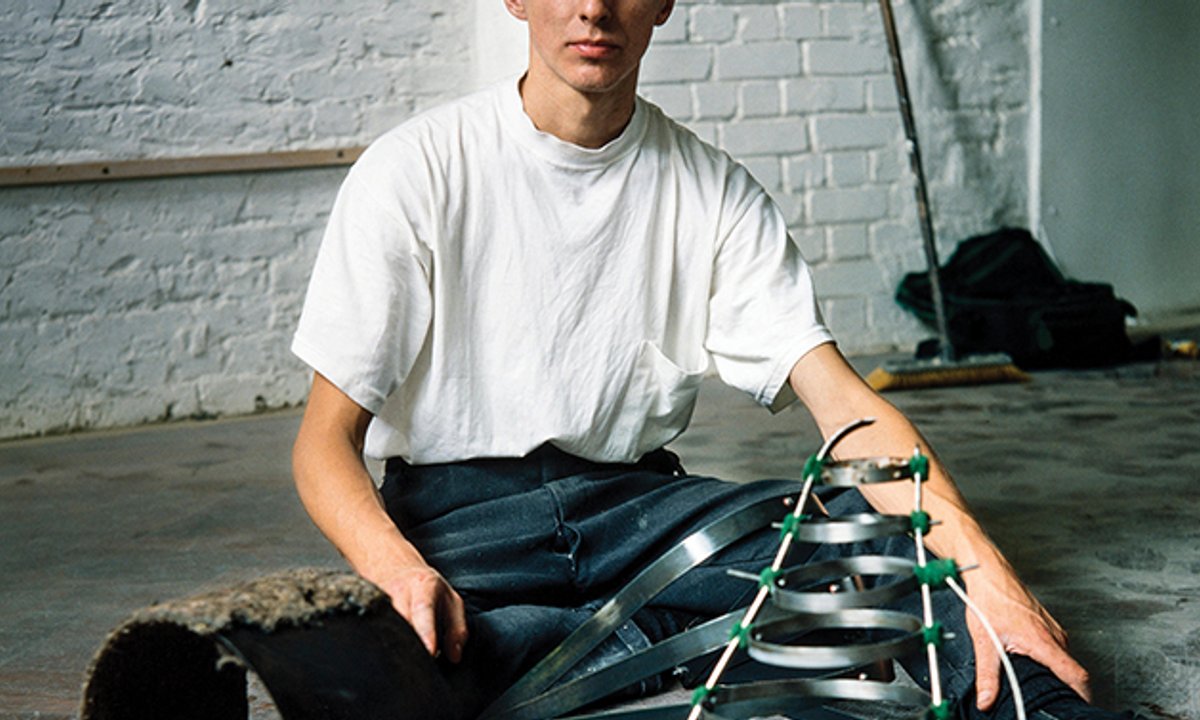
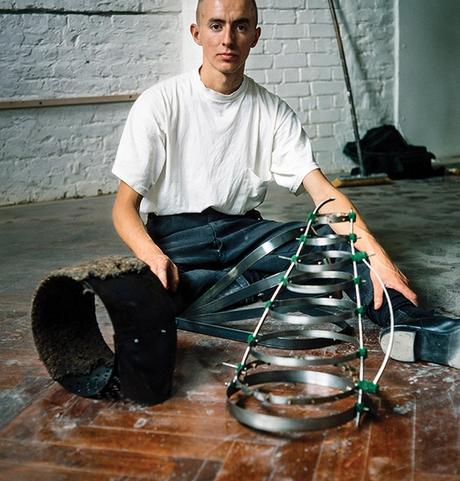
When a retrospective of the work of past Turner Prize winners was held at Tate Britain in 2007, Grenville Davey’s was shown next to Damien Hirst’s. The latter’s sculpture, Mother and Child Divided (1993)—a four-part vitrine holding a bisected cow and calf preserved in formaldehyde—retained the power to shock that had helped it win Hirst the prize in 1995. Davey’s Tate submission, by contrast, was so self-effacing that it was easy to walk past it without noticing.
Sharp (1992) was a three-dimensional drawing in off-white-painted steel that changed as the viewer walked around it. “The world is an animated place,” a reasonable Davey explained. “You move through it and it moves around you.” Yet he had beaten Hirst to the Turner Prize in 1992 with just such a work—HAL, a pair of 2.5-metre high steel columns—pitched against another Hirst vitrine, The Acquired Inability to Escape, containing a desk, a chair and an ashtray full of cigarette butts.
The three years that separated the two prizes had marked a sea change in contemporary British art. Had Davey come up against Hirst in 1995, it is unlikely that he would have beaten him. Although he was only four years older, Davey, who has died at the age of 60, came from a line of British sculpture that had begun in the late 1950s with artists such as Phillip King. Hirst was in the vanguard of a new group that was to find fame as the Young British Artists. Much YBA work would rely for its impact on personal narrative, backstories of the artists’ often insalubrious lives. Davey’s, by contrast, preached the quiet virtues of respect for materials, form, scale and the everyday.
Thus HAL, which might easily not have been sculpture at all but a pair of storage tanks in a redundant factory. Battered looking, the work bore the signs not of industrial wear but of Davey’s own facture. The twin columns might look like readymades, but they were insistently handmade: Davey’s respect for unconsidered objects extended not just to admiring their form but to recreating it, painstakingly, himself. He liked to work directly on metal, abjuring drawings. As a result, although his work was not utilitarian, it carried a strong air of utility. HAL’s two-part structure also spoke of Davey’s fascination with repetition and symmetry.
The joys of metal
Grenville Davey was born in Launceston, Cornwall, in 1961, the son of Lillian, a nurse, and Clifford, a police officer. He studied on the foundation course at Exeter College of Art and Design. It was, though, in the mid-1980s and at Goldsmiths College—also Damien Hirst’s alma mater—that he had discovered the joys of the metal workshop. “I was shy of it at first but got over it,” said Davey. “That’s where things started to take off.” Success came early. In 1987 he had his first solo show at the Lisson in London, a gallery with a long history of representing contemporary British artists such as John Latham and Americans such as Donald Judd. He would later exhibit at the Chisenhale Gallery, and, at the time of his death, with Close gallery in Somerset.
Although Davey’s work had much in common with that of an earlier generation of British sculptors, it was subtly different. If there was little of the YBAs’ post-Dada game-playing in Sharp or HAL, there was a ludic quality to Davey’s sculptures that was not to be found in the high-minded formalism of the 1960s minimalists. At times, he had a taste for the uncanny that seemed almost surreal.
In part, this was to do with the kind of object that caught Davey’s eye. These often seemed perversely modest, and his take on them literal. The wall-based sculpture Quad (1988) looked as though it had been modelled on a dimmer switch, while the two-part piece By Air (1989) might have been a pair of satellite dishes or security mirrors. Toy drums, pie tins and rubber seals were all grist to Davey’s formalist mill, although his treatment of these everyday things was never mocking.
Benign puzzlement
If his work was on a human scale, its well-crafted blowing-up in steel of objects such as a clothes button, lying heavy on the floor or propped in a corner, lent these objects a new phenomenological weight. His own take on this transformation was modest. “My work has a strong relationship with things you might see in the world,” Davey said. “It is a celebration of those daily, and sometimes mundane, objects. I don’t expect anyone to go out and see the world differently after seeing my work.”
My work has a strong relationship with things you might see in the world. It is a celebration of those daily, sometimes mundane, objects
Grenville Davey, artist
It was this shared reticence of artist and subject that lent them their power. Over any exhibition of Davey’s work hung a set of questions: why this object and not that? What is it that the artist sees in it, and wants us to see? Deprived of an obvious answer, the viewer was thrown back on a kind of benign puzzlement. If Davey claimed that he did not expect people to experience the world differently after looking at his work, that was none the less the effect it tended to have.
This same modesty made him an easy target for attack. At times, Davey’s self-effacement seemed to verge on the comical. Asked how he would celebrate winning the £20,000 Turner Prize, he thought for a moment before replying that he might take a couple of days off, adding that the money would probably ensure that he had turkey on the table for Christmas. By 1992, journalists wanted something more newsworthy; Damien Hirst, that year’s Turner Prize favourite, would certainly have supplied it. Reporting on Davey’s win, the Wall Street Journal led with the acid headline, “Grenville Who?”, going on to describe the artist as “the darkest and least exciting horse in a field of four”.
Pressured to be a show pony, Davey did the opposite: he left London for a farm in Essex, and set up a studio there. “Things got really noisy,” he recalled, “and I just had to get away.” Removed from the hugger-mugger of Hoxton, he seemed almost to disappear. So, too, his work.
From the mid-1990s, this consisted less of stand-alone sculptures and more of large-scale, site-specific pieces. One of these was Inter Alia (2011-12), commissioned for the Olympic Park in east London. A set of 61 Rolo-shaped studs cast in aluminium bronze and jutting out from a concrete retaining wall, Inter Alia took Davey’s self-effacement to new heights. Made with the help of local people, the work was intended, the artist said, to meditate on the idea of “making your mark”. The marks, though, were not his but those of his helpers, the artist likening the ringed facets of the studs to their fingerprints. As the name Inter Alia suggested, he saw his own part as merely one of many.
Grenville Davey died, suddenly, on his Essex farm, after a trip to the south-west. He is survived by a son, Sennen, from his marriage to the sculptor Victoria Burton. “It’s so lovely to be home, my own bed, gentle rain, garden, future,” he had written that day. “I will sleep well, and dream.”
Grenville Davey; born Launceston, Cornwall 28 April 1961; winner Turner Prize 1992; married Victoria Burton (marriage dissolved 2015, one son); died 28 February 2022