

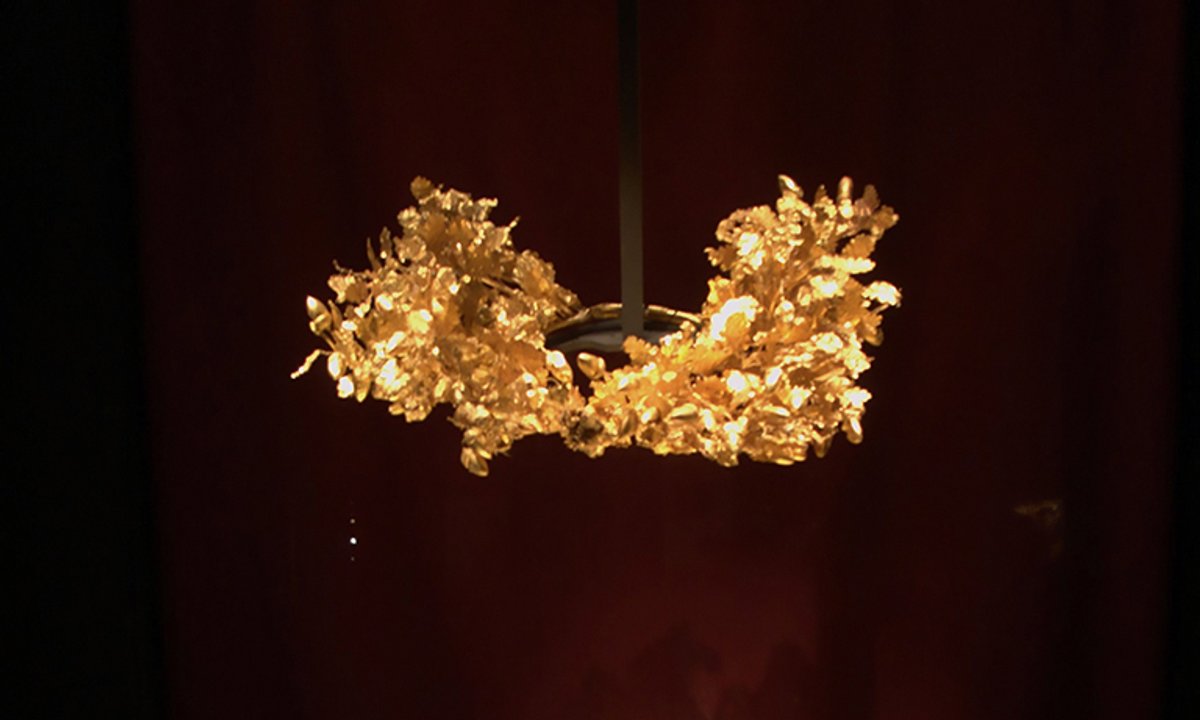
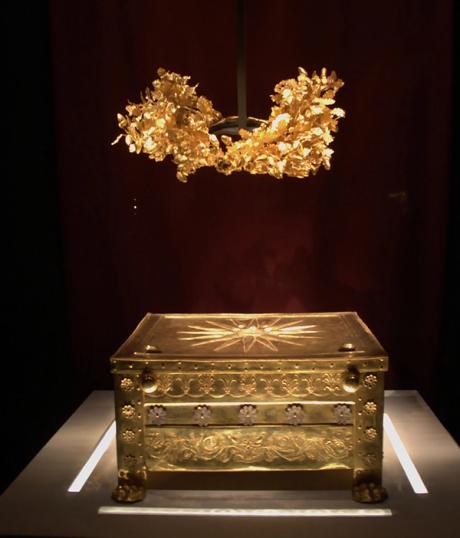
A Greek scholar says he has identified a sacred tunic once worn by Alexander the Great and interred in a royal tomb more than 2,000 years ago. Found at Vergina, 300km north of Athens, the pieces of the tunic—known as a chiton—had been kept in an ossuary with a golden wreath and what the scholar says may be the remains of Alexander’s half-brother and successor, Philip Arrhidaeus.
The golden ossuary and its contents were discovered in Tomb II at Vergina decades ago, but the pieces of multi-layered material found within have only recently been examined using scientific methods, including chemical and microscopic analyses. The scholar’s interpretation of the results challenge the widely accepted premise that Tomb II contains the remains of Alexander’s father, Philip II.
Antonis Bartsiokas, a professor emeritus of physical anthropology and paleoanthropology at the Democritus University of Thrace, Greece, concluded from the analyses that the material originally formed a purple and white tunic—an item of clothing that could only be worn by kings in ancient Persia and was adopted by Alexander the Great after he conquered the Persian empire. He further argues that Alexander is shown wearing this material in a frieze above the entrance to Tomb II.
The rare use of cotton
“The material in the golden ossuary is made of cotton,” Bartsiokas says, and the material’s structure—whitish layers between purple ones—matches the chiton worn by Alexander the Great as described in ancient literary sources. Cotton was very rare in Greece before Alexander’s empire-building campaigns, according to Bartsiokas’s research paper, published in the Journal of Field Archaeology, while dyeing an entire chiton purple would have been extremely expensive, because of the high cost of the dye.
Bartsiokas has also researched the other items found in Tomb II and concluded that many of these also belonged to Alexander the Great—and not to his father, Philip II, as previous studies have argued.
“Apart from the sacred chiton of Alexander with the eight-ray golden star discs, which is the most precious item in antiquity, we have the sacred shield, which may be the shield of Achilles used in the Trojan war or a copy of it, his silver gilded diadem, his golden sceptre, his cuirass, his iron helmet and his golden oak wreath, to mention the most certain ones,” Bartsiokas says. He adds that the sacred tunic, sceptre and diadem are all of Persian origin.
Alexander the Great, a Macedonian king, died in Babylon, in what is today Iraq, in 323BC. His body was eventually buried in Alexandria, Egypt, in a tomb that is now lost, but not all his belongings followed him. How these items ended up in Greece is explained by classical writers.
“The ancient sources report that Arrhidaeus inherited them from his half-brother Alexander the Great and transported them to Macedonia where he was buried with them as the last of Alexander’s dynasty,” Bartsiokas says. “The rest of the items were transported to Egypt.”
Philip Arrhidaeus (Philip III) inherited the crown of Macedon after Alexander’s death. He was present in Babylon when Alexander’s body was displayed alongside the royal diadem, sceptre and wreath, and is described as having later worn the sacred tunic. After spending his short reign controlled and influenced by others, Arrhidaeus was executed in 317BC on the orders of Alexander’s mother, Olympias. According to Bartsiokas’s study, Arrhidaeus’s remains were then interred in Tomb II at Vergina—known as Aigai in ancient times—along with the other items he had inherited from Alexander.
Although the royal tombs at Vergina are securely identified as the burials of Alexander’s relatives, their dating and specifically which family members were buried in which tombs has long been a matter of heated debate.
The central question is whether Alexander’s father was buried in Tomb I or Tomb II. Bartsiokas argues that Philip II was buried in Tomb I. “The identification of cotton in Tomb II is a conclusive argument for a post-Alexander date for Tomb II as there was cotton in Persia but not in ancient Greece,” he says. His conclusion that Tomb II instead belongs to Arrhidaeus is also supported by a study he produced with colleagues of the skeletons from Vergina, published in the Journal of Archaeological Science: Reports in 2023.
Dissenting voices
“The knee fusion of the male, the very young age of the female and the presence of the newborn bones all show that Tomb I belongs to King Philip II as all this physical evidence is reported in the ancient literary sources,” Bartsiokas says. “The male of Tomb II has no injuries at all. This means it can neither belong to Philip II who had four injuries, nor to Alexander the Great, who had ten injuries. It belongs to King Arrhidaeus (Philip III) who had no injuries at all.”
Bartsiokas adds: “What matters is that Greece has the insignia of Alexander the Great and the visitors of the Vergina Museum will at last have the chance to admire the personal items of Alexander the Great—not those of his father King Philip II, as it was believed so far.”
Bartsiokas may still have some work to do in persuading his peers.
“The discovery is most interesting and exciting, but like other artefacts from the tomb that are used to try to remove Philip II as the occupant of the main chamber, the significance of the sacred ‘chiton’ is based on interpretation,” says Ian Worthington, a professor of ancient history at Macquarie University, Australia, who was not involved in the research. “Philip II still remains the most likely occupant of this tomb.”