

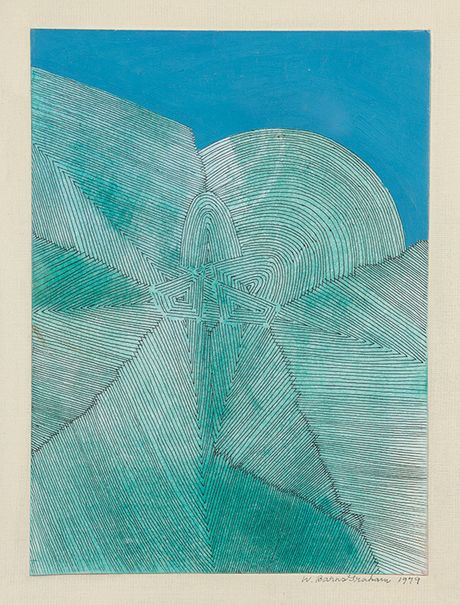
The glacier paintings of Wilhelmina Barns-Graham (1912-2004) are some of her best-known works. When the Scottish artist visited the Grindelwald Glacier in Switzerland in May 1949, she could not have imagined that the landscape she encountered there would sustain her interest for almost a lifetime. This new book, which presents a variety of approaches and responses, is the first comprehensive account of these works, exploring their origins and development, as well as the role they played in Barns-Graham’s career. It is apt they are celebrated now, 75 years after her visit to Switzerland.
She could not have imagined [the glacial landscape] would sustain her interest for almost a lifetime
Following her training at Edinburgh College of Art, Barns-Graham moved to St Ives, Cornwall, in 1940, joining a creative community that included Barbara Hepworth, Ben Nicholson and Naum Gabo, and centred on the home of Margaret Mellis and Adrian Stokes. As the art historian Alice Strang’s essay explains, at this time Hepworth and Gabo worked with spirals, cavities and tensions, while Mellis, Peter Lanyon and John Wells explored Constructivist practices. For her part, Barns-Graham fell back on the observational drawing of her art-school training, although it would not be long before shifts in her painting saw a flattening of the picture space, an interest in the geometry of form, and an interrogation of the relationship between interior and exterior.
The Grindelwald trip was a watershed when, as Strang puts it, the artist developed a “glacial” vocabulary such that meltwater holes, striations, ovals and vertical structures of monumental mass became the common language of her icescapes and her “total experience” of the glacier. Barns-Graham’s reputation was bolstered with group and solo exhibitions of the glacier paintings, which reoccurred in three subsequent periods of her career—the late 1970s, the mid-1980s and 1994.
The archival material around Barns-Graham’s trip to Switzerland is not extensive. Yet, as the archivist Tilly Heydon explains, the collection of letters, photographs, notes, drawings and exhibition ephemera bring us as close to her experience as is possible. This provides crucial context for the paintings and drawings as well as evidence of the lasting impact of the trip.
Contemporary contributions
That context is widened with contributions from contemporary poets. Holly Corfield Carr’s response explores how a single glacier painting can spark the imagination, firing new perspectives on the ordinary and the extraordinary. She picks up on Barns-Graham’s note from 1965, that “in a few days a thinness could become a hole”. Carr’s play with language ends with a perfect hole within the printed words on the page: concrete poetry imitating art. Perhaps her most exquisite observation is that this thinness is “like a breathless kind of anagram” in its silent transformation.
Another poet, Alyson Hallett, takes a different approach in her “Glacier Nocturn”, comparing Barns-Graham’s experience of the glacier with that of the city at night, and the artist’s body with an ice cave, folding ideas of architecture and music seamlessly into a cornucopia of imaginative thinking. A third creative response comes from the film-maker Mark Cousins, in the form of an imagined letter to Barns-Graham that considers his own preconceptions, which shift following a visit to the Alps. This trip was, on his account, a profound experience that changed his sense of who Barns-Graham was, bringing fresh understanding of the complexity she saw in the glacier.
A glaciologist’s view of the paintings, given by Peter Nienow, is perhaps the most fascinating chapter in the book. Nienow gives a clear explanation of glacial phenomena for the layperson, but he does much more than that. He looks closely at Barns-Graham’s images, making a visual comparison between them and photographs of glacial features. In so doing it becomes clear that the “abstraction” of Barns-Graham’s paintings relates to the nature of supraglacial lakes—surface meltwater and chaotic crevassing, ice blocks and seracs. The revelation is fascinating.
The full catalogue of the glacier works is a helpful element of this book, but perhaps its most admirable quality is the wide range of authors, all bringing different perspectives to bear upon them. It is the combination of those perspectives that affords the reader a rich and nuanced understanding of the paintings and Barns-Graham herself. Short of visiting Grindelwald Glacier in person, the total experience of this book is surely the next best thing.
• Rob Airey (ed.) with contributions by Holly Corfield Carr, Mark Cousins, Alyson Hallett, Tilly Heydon, Peter Nienow, Cassia Pennington and Alice Strang, Wilhelmina Barns-Graham: The Glaciers, Lund Humphries, 128pp, 115 colour and 10 b/w illustrations, £19.99 (pb), published 7 October
• Beth Williamson is an independent writer, critic and art historian, and is writing a book on the Scottish artist William Johnstone (1897-1981)