


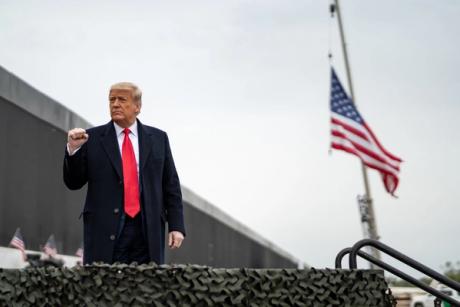
In the first 100 days of his second term, the administration of US President Donald Trump wasted no time enacting a plan to force the cultural sector into ideological conformity. A slew of drastic and possibly unconstitutional executive actions have pushed cultural institutions—including museums, libraries, performing arts and educational institutions—to a critical moment of reckoning. Caught between losing funding and viability, or losing credibility and integrity, how should these institutions respond? And do they really have a choice?
Executive orders banning anything related to diversity, equity, inclusion or gender threaten to restrict cultural funding administered by the National Endowment for the Arts (NEA) and the National Endowment for the Humanities (NEH), though the latter had its budget slashed by 85% before it could even be assessed as non-compliant. The Smithsonian Institution was directed by executive order to eliminate “improper, divisive or anti-American ideology” from its museums. The formerly independently-run and nonpartisan Kennedy Center for the Performing Arts is now under the direct supervision of the US President and has since cancelled multiple performances, many of which contain LGBTQ+ themes.
A garden for ‘American heroes’
Meanwhile, the administration is clear about what it does want to fund. Part of the slashed NEH budget will finance a patriotic sculpture garden of “American Heroes”. The NEA’s new requirements for its Grants for Arts Projects “encourage projects that celebrate the nation’s rich artistic heritage and creativity by honouring” the US semiquincentennial in 2026. The Smithsonian is mandated to be nothing but “a symbol of inspiration and American greatness”. That America would be made “great again” with such programmes is unlikely, especially when it has been admired precisely for the freedoms it upholds—chief among them the freedom of speech, including the ability to criticise the US and its history. What is certain is the administration’s desire to force cultural institutions to celebrate—and never question—America’s past and present greatness, real or imagined.
While recipients of federal funding are left to question whether to remove blacklisted words from publicity materials, cancel upcoming programmes, adjust project proposals or simply abandon the quest for government funding altogether, the impacts do not end here. The McCarthyist crusade against pro-Palestinian expression has higher education (and by extension, the art that is shown on campuses) in its crosshairs. The Rhode Island School of Design (RISD), a private school, recently censored a student exhibition containing pro-Palestinian views, on the premise that restricting viewership to students would better protect the school from federal antisemitism investigations. Even private arts organisations risk new scrutiny. Recently, the Internal Revenue Service launched a formal investigation of Creative Capital for a programme that prioritised awards for artists of colour, which may jeopardise the group’s nonprofit status.
Leaders of cultural institutions have difficult decisions ahead, but rather than abandon their missions, they should put them into action—even if doing so requires unconventional approaches or presents a risk. Understandably, not every institution has the connections or financial resources to take an outspoken public stance. But institutional displays of courage enact a commitment to principle, independence and integrity, offering a model for other institutions and signalling solidarity with those whose expression is targeted by executive actions.
Institutions should not only act with courage and on principle; they must be strategic about the risks they take
Institutions should not only act with courage and on principle; they must be strategic about the risks they take. Risks can be hedged through community-building, creativity, and flexibility—and through learning from the accumulated experience of cultural institutions working in repressive regimes. Many institutions will have to operate with a reduced budget if they want to preserve their autonomy, and some may be forced to do so even if they surrender it. Bolstering institutional networks, however, can reveal opportunities for mutual aid and for enlisting the support of public opinion. The framing and contextualisation of potentially controversial projects could be adjusted to fly under the radar of the censors. Programmes may need to be promoted differently; maybe some events are not advertised online or even announced at all. Inspiration and instruction can also be drawn from marginalised creative groups across history that have found ways to continue to do the work even under the most dire of circumstances.
No single failsafe measure exists, and this is true even in a relatively healthy political climate. In 2012 the National Coalition Against Censorship (NCAC) and six institutional co-authors launched “Museum Best Practices for Managing Controversy”, a resource to help cultural institutions prepare for exhibitions of sensitive work, and for potential backlash. Some of its recommendations are still apt under a regime of government-mandated culture, and NCAC is working with allies to further develop concrete strategies for responding to autocratic pressures.
There are serious risks to standing up to the demands of an increasingly autocratic administration, but it is important to remember that the alternative is also risky. Consider the National Archives, which hastened to make changes to exhibitions to conform with the ideology of the current administration, even before it took power. Among them, an image of Martin Luther King Jr at a civil rights protest was replaced with one of President Nixon greeting Elvis at the White House; in an exhibition about patents, a display about the birth-control pill was replaced with one about bump stocks. Even so, the archives’ director was fired in February.
At the time, a spokesperson for the National Archives stated: “Leading a nonpartisan agency during an era of political polarisation is not for the faint of heart.” True indeed. Non-compliance can cost an institution its funding or its leadership their jobs, but complying in advance betrays the demands of institutional integrity in the delusion that doing so will guarantee protection. In an autocracy there is no safety: deals struck with power undermine credibility, only to be revoked at whim. Under such conditions, cultural leaders can stand by their principles, and the values that make an open culture (and democracy) possible in the first place.
• Elizabeth Larison is the director of the Arts and Culture Advocacy Program at the National Coalition Against Censorship