

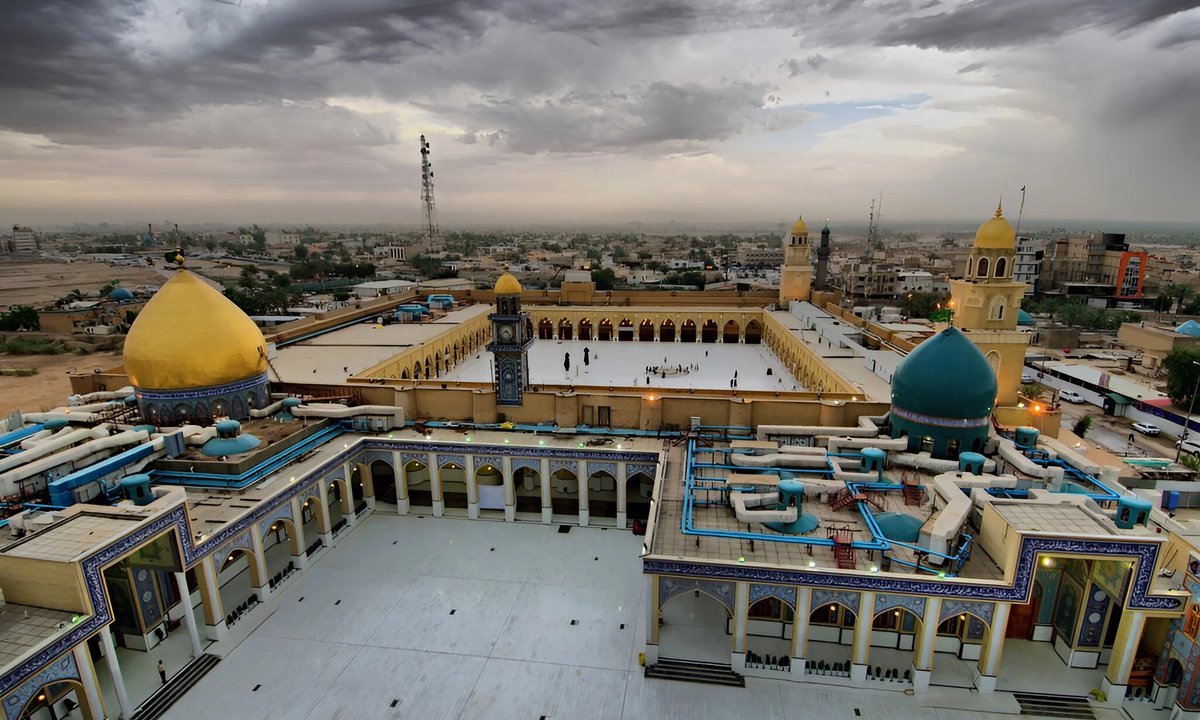
A battle has erupted to save the archaeological site of Tell Al Sayyagh, part of the ancient city of Kufa in Iraq. The fierce discussion hinges on a growing issue in the country: the so-called “investment law”. Critics allege that members of Iraq’s State Board of Antiquities and Heritage (SBAH) have used the law to allow development on hundreds of important ruins over the past ten years—sites now lost forever, chewed up by bulldozers and buried under concrete.
“They are destroying the country’s heritage, and they are doing it legally,” says one archaeologist, who asked to remain anonymous.
Real-estate development has been allowed on important sites such as Al-Hira, the pre-Islamic capital of southern Iraq, which now partly lies under the Najaf airport; Old Basra, one of the largest cities in Iraq during the Islamic period; and in southern Hillah, near Babylon, as well as in Babylon itself. In Baghdad, Babylonian, Sassanid and Seljuk-era archaeological remains have all been demolished.
Now, Tell Al Sayyagh is at risk. The area, which stretches over around 75 acres, dates to Kufa’s golden age of the seventh to eighth centuries and is one of the last untouched sites from that time. The medieval city was a centre of learning and culture—a legacy that lives on in Kufic script, the prominent calligraphic style—and a cosmopolitan nexus along pilgrimage and trading routes.
“The site bears witness to the existence and establishment of ancient Kufa,” says Aqeel Ghaleb Al-Kharifawi, the chair of the Popular Committee for the Protection of Antiquities and Heritage in Iraq, a local NGO that is fighting to preserve the land. “Through it, we can deduce the layout of the old city, as it contains buildings for the market for gold and silversmiths and money-changers, who came from the neighbouring kingdom of Al-Hira. Most of these were Christians. Without Tell Al Sayyagh, we have no remaining sites from which to prove this.”
Tell Al Sayyagh also sits in the middle of modern-day Kufa, a wealthy city where land commands a high price. In 2017, an entity registered as the Andalusian Wall Company applied to build a residential complex on the ruins, but the application was rejected because of Tell Al Sayyagh’s importance. Since then, however, the decision has been reversed incrementally. In 2023, the Najaf Investment Authority split the plot in two—a division that critics hold is arbitrary—and allowed the company to build on the slightly smaller portion.
Then, late last year, according to court documents viewed by The Art Newspaper, the Andalusian Wall Company asked to develop the larger plot. After several appeals and challenges, the company was given the go-ahead to build a residential complex at a cost of $77m in March.
Ali Obaid Shalgham, the director-general of the SBAH, and Suhail Al-Tamimi, the head of the excavations department, did not respond to enquiries about why the SBAH reversed its decision despite its earlier statements about Tell Al Sayyagh’s historical importance.
Public opposition
The decision has elicited protests in Kufa and Najaf as well as strong condemnation on social media. The public opprobrium is highly unusual: though several archaeologists who were interviewed for this article view the investment law as a scourge, many have kept quiet out of fear of jeopardising their relationships with the SBAH. According to one, after a number of archaeologists last year commented on social media about the razing of a 700-year-old mosque in Basra, one was punished with administrative fines.
The investment law was issued in 2006 and then adapted in 2010 and 2015 to aid development and encourage overseas investment. Its use has increased in the past three years as economic activity has picked up. It allows companies to petition the SBAH to change the classification of archaeological sites to build on them. Sites in culturally rich Iraq are put into three categories—A: major heritage areas such as the Ashurbanipal palace near Mosul, which are so crucial that they will always remain protected; B: those on which work is ongoing and should be safeguarded from commercial development; and C: those that have notable but not overwhelming levels of historical significance. The investment law in effect makes sites from the middle category admissible for development, after an excavation has confirmed that the site does not yield significant findings.
While this sounds good on paper, in practice archaeologists say that the SBAH’s surveys are mere perfunctory exercises, conducted to rubber-stamp the sale of the land. “These are excavations that should take five to six years, and they do them within months—without proper tools—so that they can say that there was nothing there,” says one archaeologist.
Others go further, contending that there is a financial incentive at play. The investment law, notably, has been mostly used in large cities, where the price of the land is greatest, while more remote sites have been left alone. And as Iraq’s economy grows, the fear is that cultural heritage will increasingly be its victim.
“If the law continues to work in this way,” says one critic, “the archaeological sites will be destroyed and no rich sites will remain in Iraq.”