


The year 2025 has marked a boom in museum architecture, with new buildings and buzzy expansions underway worldwide. As several projects come to fruition, the current crop of designs offers an opportune moment to take stock of museum architecture today. While many endeavours are innovative—particularly outside the US—some of the biggest commissions of the year have been either striking for the wrong reasons or immediately forgettable.
As houses of artistry and culture, museums have significant flexibility when it comes to appearance. Each has its requirements, but architects can flex their creative muscles with innovative designs that might not fit other purposes. It is no wonder, then, that some of the most exciting designs globally—like Frank Gehry’s Guggenheim Museum Bilbao in Spain and Zaha Hadid’s Maxxi in Rome—are museums. These are not without controversy, of course, but they do create intrigue and start a conversation. Given this opportunity to be daring, it is even more disappointing when architects earn museum commissions only to deliver a boring design.
A buzzworthy new building in the US is the Princeton University Art Museum (PUAM) in New Jersey. Designed by Adjaye Associates in collaboration with the executive architect Cooper Robertson, the museum features dark serrated concrete and strong vertical lines along the exterior. Spanning multiple wings of differing volumes, the ribbed surfaces have minimal windows, masking the activities inside. Though the lower-level windows do lighten the design, the museum recalls a menacing office one might see in a film. Overall it creates a sense of foreboding.
In judging PUAM’s exterior, I am reminded of a conversation I had last spring with Martina Droth, the director of the Yale Center for British Art (YCBA) in New Haven, Connecticut. At the time, we were discussing the reopening of the museum’s Louis Kahn-designed building, which had been closed for refurbishment. “It is difficult for us to present a friendly face,” Droth told me. “Some people don’t know that we are a museum because of our name, or are intimidated because of our academic association.” To help entice visitors, the YCBA is actively programming eye-catching art in its lobby. The museum’s front desk and bookstore even received an award from the American Institute of Architects in Connecticut. Surely the new PUAM will face the same challenges as the YCBA.
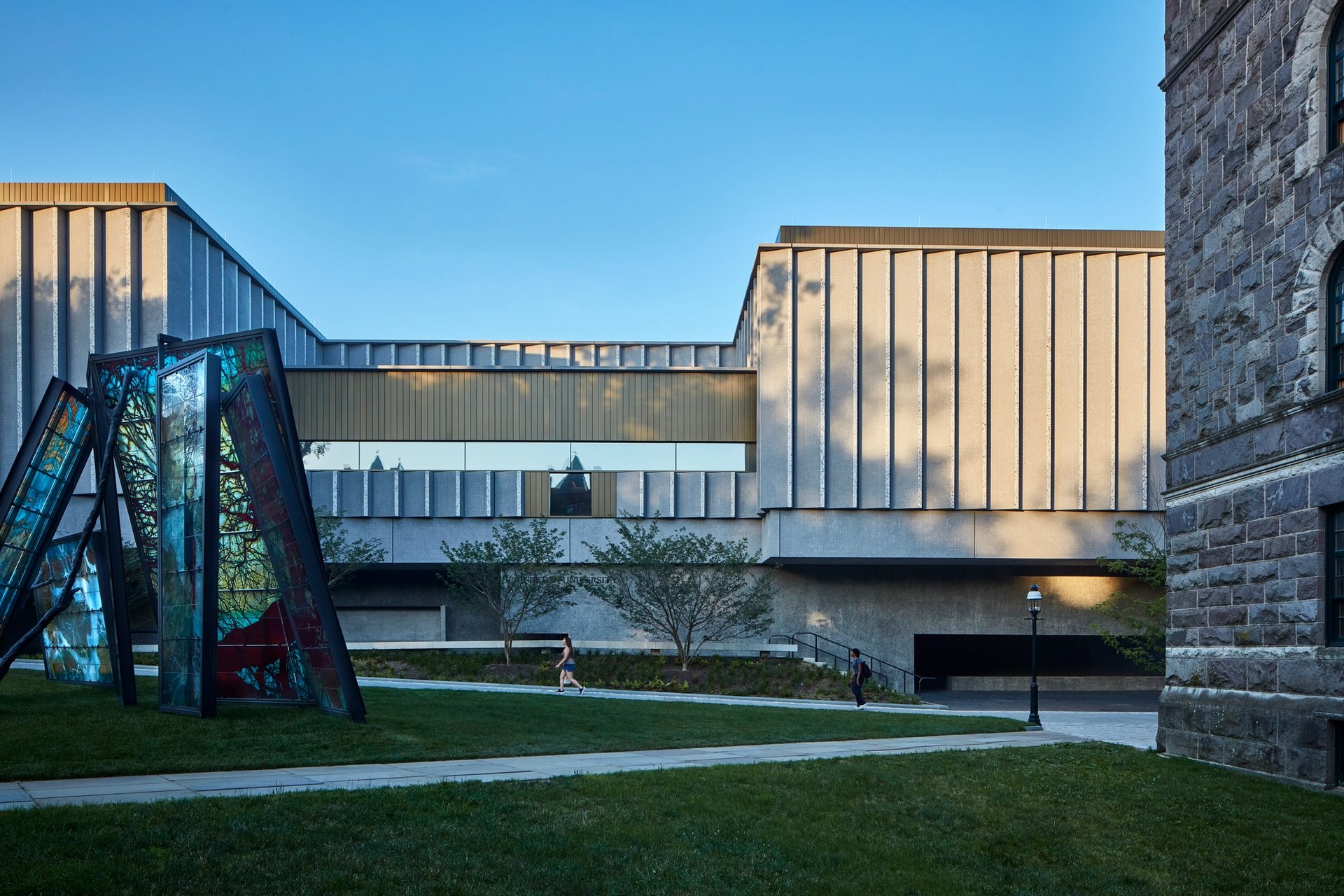
The Princeton University Art Museum Photo: Richard Barnes Courtesy Princeton University Art Museum
A similar story in two Portlands
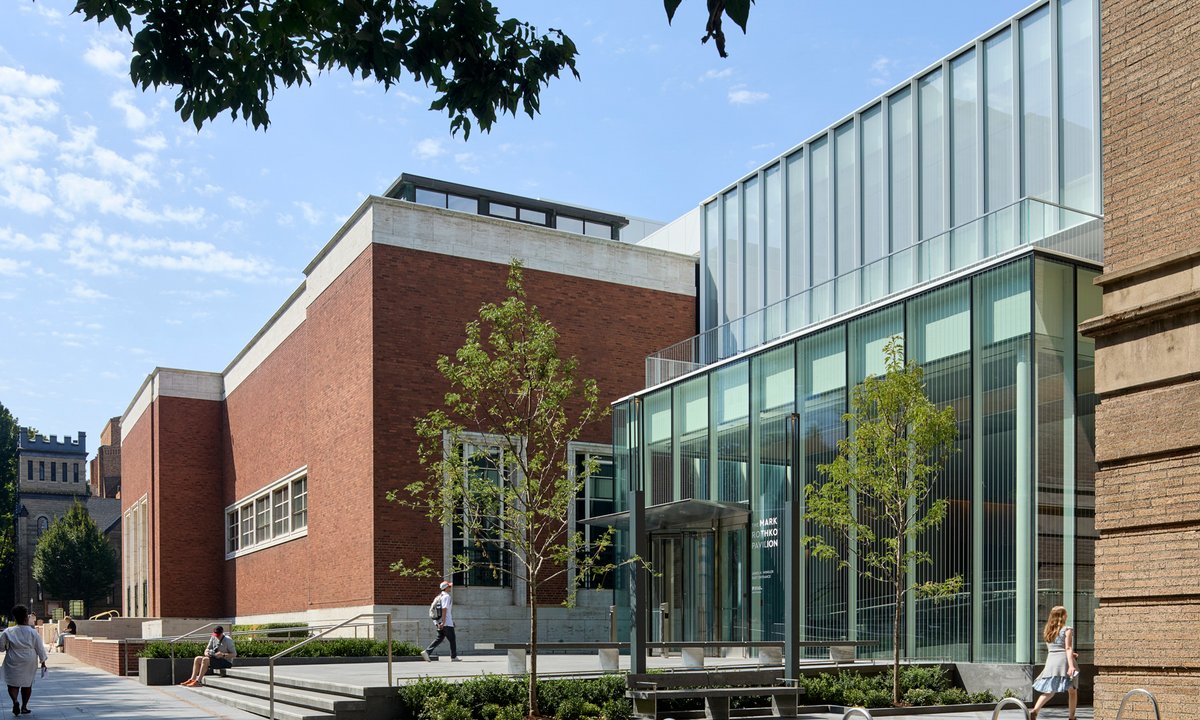
Designs with elements similar to PUAM are popping up across US museums. In Oregon, the Portland Art Museum completed an expansion called the Mark Rothko Pavilion. The new space again features distinct volumes and strong vertical lines from window seams along the façade. Unlike PUAM’s dark, serrated concrete, the Oregon museum welcomes visitors with an expanse of windows, some cloudy to diffuse direct sunlight. Designed by Hennebery Eddy Architects with Vinci Hamp Architects, the expansion resembles a close-up of PUAM on first glance.
Likewise, the Portland Museum of Art in Maine is undergoing an expansion to unify its campus. Designed by Lever Architecture, the building features sustainable mass timber and soaring façades of windows that are divided into cubes. Relying on distinct vertical lines and with volumes clearly delineated, the similarities with Adjaye’s aesthetic are clear.
To be fair, strong vertical lines and pared-down façades are not new in museum architecture. The architect Renzo Piano made this a staple, earning him commissions worldwide such as the Menil Collection in Houston and Fondation Beyeler in Switzerland. But Piano knows when to throw in a curve, protruding armature or industrial material. Moreover, I am focusing only on the outside of museum buildings, but as the barrier between the public and the art contained within, the exterior impression can be the difference between a visitor passing through the door and walking by.
More dynamic than PUAM is Adjaye’s other new US building in collaboration with Cooper Robertson, the Studio Museum in Harlem, which consists of dark, hefty cubes of different sizes stacked on top of one another. Walls of windows fill some cubes, welcoming the public with a glimpse of the activities inside. The nearly solid volume that sits atop the building feels clunky, but it juxtaposes the expanses of windows. Still, the Studio Museum bears characteristics of today’s trends, perhaps a result of Adyaje’s thumbprint and his broader influence. Though both institutions have distanced themselves from the firm after David Adjaye was accused in 2023 of sexual assault (he denies the allegations), the architect’s vision remains clear. But compared to other new buildings, it is easy to be disappointed by his style.
Take, for example, the Buffalo AKG Art Museum in upstate New York, which tapped Shohei Shigematsu of OMA to expand its campus with a predominantly glass, jewel box-shaped building that emanates light. Or look to Diller Scofidio + Renfro’s design for the Broad in Los Angeles, both its existing building and the expansion. The original structure, one large volume draped in a lacy white veil, immediately piques curiosity. For the expansion, the firm balanced the veil with another large cube, this one enveloped in a smooth, grey exterior with soft recessions ending in windows and viewing platforms. The expansion, which the museum’s founding director Joanne Heyler says “is designed to signal access, playfulness and a generous embrace of the visitor”, is exemplary of how a museum can support innovative architecture while satisfying the needs of its collection.
The Powerhouse Parramatta in Western Sydney offers another elegant example. Abutting both an urban centre with skyscrapers and a tree-lined neighbourhood, the building by Moreau Kusunoki features distinct exterior columns oriented to resemble the letters A, N, W and X. In addition to delineating different levels of the building, these letters in their individual rows break up the façade and achieve a lace-like geometric design.
Indeed, looking outside the US offers an abundance of exciting new museum projects. Gehry’s design for the Guggenheim Abu Dhabi is nothing short of spectacular, with its cascading pile of geometric shapes and juxtaposing metal, glass and concrete surfaces. Also in Abu Dhabi is Foster + Partners’ Zayed National Museum, featuring soaring vertical latticed wings inspired by the region’s history of falconry. In Rotterdam, a stainless-steel double helix crowns the Fenix museum of migration. Offering insight into just how far design can reach, these buildings will undoubtedly draw visitors as excited to see the exteriors as they are to experience the art housed inside.
As trends go, one can only hope the style spreading through US museum design today will eventually fall out of fashion. All forms of creativity could use moments of self-reflection; perhaps it is time some museum architecture has its own.