
• About
  • Landing Page
  • Buy JNews
Newsletter
Impact Crypto News
Advertisement
  • Home
  • DeFi News
  • EVM News
    • Avalanche Network
    • Ethereum
    • Fantom Opera Chain
    • Harmony Chain
    • Huobi Eco Chain
    • Polkadot Chain
    • Polygon Chain
  • NFT News
  • Altcoin News
  • Crypto News
    • Crypto Regulation News
    • Bitcoin
    • Blockchain
    • Crypto Exchanges
    • Crypto Mining
    • Metaverse
    • Scam News
    • Web 3.0
No Result
View All Result
  • Home
  • DeFi News
  • EVM News
    • Avalanche Network
    • Ethereum
    • Fantom Opera Chain
    • Harmony Chain
    • Huobi Eco Chain
    • Polkadot Chain
    • Polygon Chain
  • NFT News
  • Altcoin News
  • Crypto News
    • Crypto Regulation News
    • Bitcoin
    • Blockchain
    • Crypto Exchanges
    • Crypto Mining
    • Metaverse
    • Scam News
    • Web 3.0
No Result
View All Result
Impact Crypto News
No Result
View All Result
Home NFT

4,000-year-old ancient city discovered in Peru – The Art Newspaper

IMPACTCRYPTO by IMPACTCRYPTO
July 16, 2025
in NFT
58 0
0
4,000-year-old ancient city discovered in Peru – The Art Newspaper
189
SHARES
1.5k
VIEWS
Share on FacebookShare on Twitter


Located just 12 kilometres from the Sacred City of Caral-Supe in present-day Peru, Peñico flourished between 1800BC and 1500BC—roughly concurrent with the Shang Dynasty in China and Ancient Egypt’s Middle Kingdom. The ancient city’s discovery, announced earlier this month, was the result of eight years of research led by the archaeologist Ruth Shady. The site opened to the public on 12 July, revealing its profound historical value as part of a crucial effort to grasp Peru’s complex pre-Columbian societies and challenge deeply entrenched myths about them.

For centuries, it was mistakenly believed that pre-Columbian civilisations were unchanging, small, nomadic and culturally backwards. However, modern archaeological discoveries demonstrate the existence of complex societies with advanced agricultural and architectural systems, as well as extensive knowledge of ecology, astronomy and mathematics prior to the arrival of Europeans on the continent. Peñico is a testimony to this sophistication.

The city’s strategic location at 600 metres above sea level, on a geological terrace near the Supe River and surrounded by mountains, was not a coincidence. The site’s architects, heirs to Caral’s traditions, built it there to emphasise the monumental size of their structures, protect themselves from floods and landslides and, crucially, foster trade. This allowed Peñico to function as a vital point of connection between the Peruvian coast and the highlands, joining together pre-Incan cultures as well as communities from the Andean-Amazonian territories and the region’s high Andean zones.

Research suggests that the site flourished following the decline of the city of Caral, making use of the economic dynamics and networks of social interaction that had already been solidified in previous periods to achieve its own prestige. Shady, who also led the excavation of Caral more than 30 years ago, notes that Peñico helps answer questions about the fate of the Caral civilisation following its decline as a result of climate change.
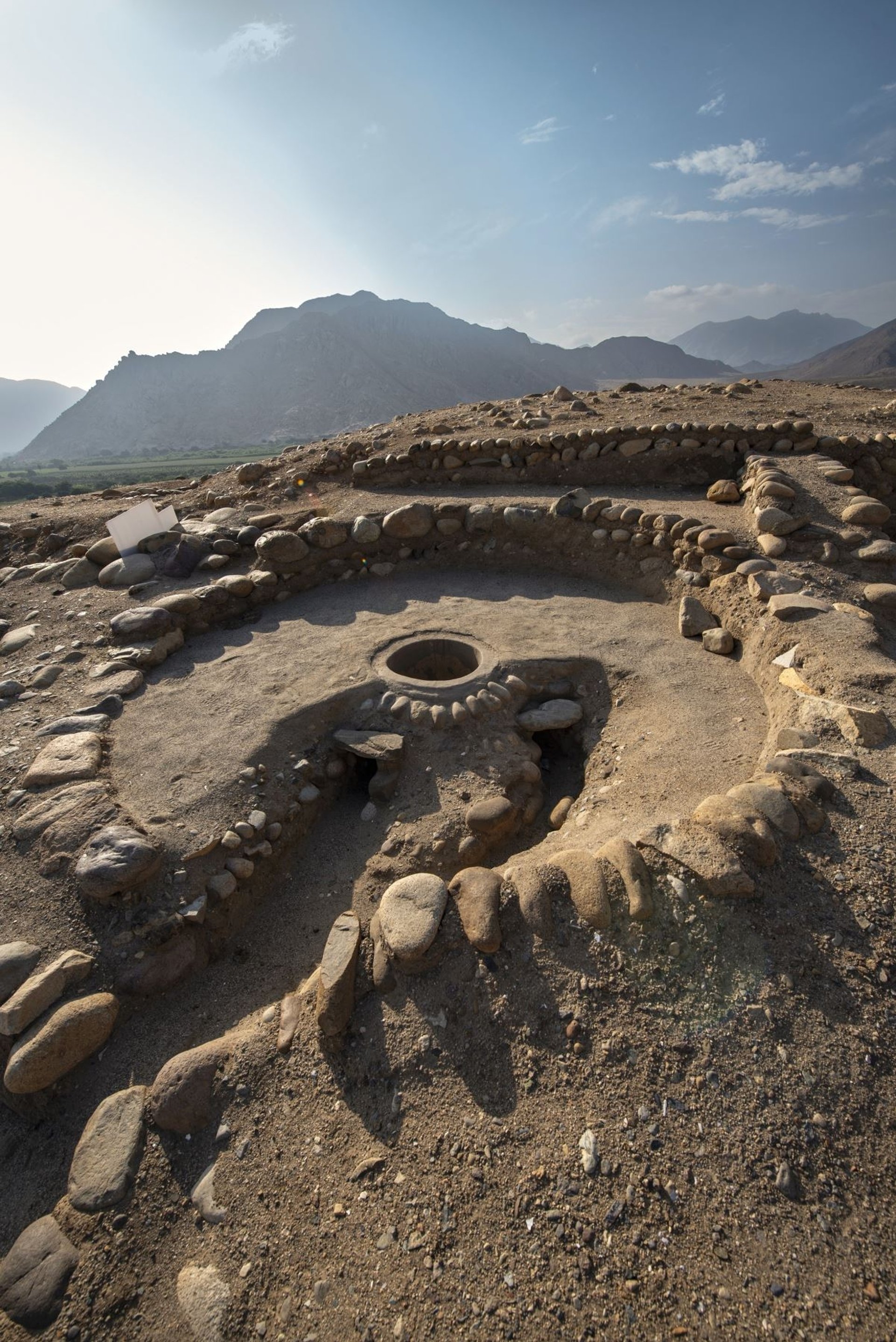
The ancient city of Peñico Photo: Andina Agencia de Noticias / Difusión

Marco Machacuay, an archaeologist and researcher with Peru’s cultural ministry, stresses the importance of Peñico as a continuation of the Caral civilisation. Notable among the 18 structures identified at the site is a large public building dubbed B2, or the Ceremonial Hall of the Pututus. This quadrangular space is thought to have been the site of the most important administrative and ideological activities in Peñico. Its reliefs and designs featuring pututus, musical instruments made from seashells that were used to call people to assemble or announce events, reveal its importance.

The presence of unfired clay sculptures (depicting human figures, animals and ritual objects), along with necklaces made from mollusc shells, gemstones like rhodochrosite and chrysocolla and animal bones, as well as stone tools, reveal a highly organised society with a constant flow of trade. The discovery of figurines of monkeys and other primates suggests a knowledge of the Amazonian region and its fauna, expanding the city’s cultural scope.

Peñico’s economy was based on farming using sophisticated irrigation methods and trade. Its primary trade resource is believed to have been hematite, a mineral important in Andean cosmology that was used to make red pigment.

Research suggests that Peñico was a vital hub in the early history of humankind in the Americas. It is a symbol of the resilience and cultural continuity that followed Caral, a civilisation that collapsed because of climate disasters such as droughts and floods. This new centre of trade prospered thanks to its inhabitants’ ability to adapt their social and economic structures to survive and thrive in the face of environmental challenges.
Source link

Related articles

17th edition of Ecuador’s Bienal de Cuenca has a playful theme but a serious tone – The Art Newspaper

17th edition of Ecuador’s Bienal de Cuenca has a playful theme but a serious tone – The Art Newspaper

December 16, 2025
Art Fund awards £1.2m to 29 UK museums to support ‘innovative’ projects – The Art Newspaper

Art Fund awards £1.2m to 29 UK museums to support ‘innovative’ projects – The Art Newspaper

December 16, 2025
Tags: 4000yearoldancientartbitcoin newsCitycrypto analysiscrypto newsdiscoveredEthoz EdgeLatest bitcoin newslatest crypto newsNewspaperPeru
Share76Tweet47

Related Posts

17th edition of Ecuador’s Bienal de Cuenca has a playful theme but a serious tone – The Art Newspaper

17th edition of Ecuador’s Bienal de Cuenca has a playful theme but a serious tone – The Art Newspaper

by IMPACTCRYPTO
December 16, 2025
0

Marking its 40th anniversary, the 17th Bienal de Cuenca, titled The Game, opened on 24 October. Its inauguration coincided with...

Art Fund awards £1.2m to 29 UK museums to support ‘innovative’ projects – The Art Newspaper

Art Fund awards £1.2m to 29 UK museums to support ‘innovative’ projects – The Art Newspaper

by IMPACTCRYPTO
December 16, 2025
0

Art Fund, the UK’s national charity for art, is giving a total of over £1.2m to 29 museums and galleries...

MoMA explores how African studio portraits offered a new vision of freedom – The Art Newspaper

MoMA explores how African studio portraits offered a new vision of freedom – The Art Newspaper

by IMPACTCRYPTO
December 16, 2025
0

When young men and women stepped into studio backdrops to have their photograph taken in Bamako, Kinshasa and Accra in...

56 participating artists, duos and collectives revealed for 2026 Whitney Biennial – The Art Newspaper

56 participating artists, duos and collectives revealed for 2026 Whitney Biennial – The Art Newspaper

by IMPACTCRYPTO
December 15, 2025
0

The Whitney Museum of American Art has revealed the 56 artists, duos and collectives that will participate in the 2026...

Pussy Riot branded ‘extremist organisation’ by Russian court – The Art Newspaper

Pussy Riot branded ‘extremist organisation’ by Russian court – The Art Newspaper

by IMPACTCRYPTO
December 15, 2025
0

A Moscow court has today ruled the feminist punk protest collective Pussy Riot to be an “extremist organisation”. The decision...

Load More

Welcome Back!

Login to your account below

Forgotten Password?

Retrieve your password

Please enter your username or email address to reset your password.

Log In
Please enter CoinGecko Free Api Key to get this plugin works.
No Result
View All Result
  • Home
  • DeFi News
  • EVM News
    • Avalanche Network
    • Ethereum
    • Fantom Opera Chain
    • Harmony Chain
    • Huobi Eco Chain
    • Polkadot Chain
    • Polygon Chain
  • NFT News
  • Altcoin News
  • Crypto News
    • Crypto Regulation News
    • Bitcoin
    • Blockchain
    • Crypto Exchanges
    • Crypto Mining
    • Metaverse
    • Scam News
    • Web 3.0

© 2018 JNews by Jegtheme.